Renaissance
Alexandre Le Clerc de Pulligny
1585, after 1659
Nancy, Lorraine
Knight of the Order of Saint Mark (Republic of Venice) · Restored to hereditary nobility, 28 May 1623 · Secretary to Charlotte Catherine de La Trémoille, Princess of Taranto · Valet de Chambre and Court Musician of the Duke of Lorraine · Resident of Érize-Saint-Dizier
⚭ Madeleine Platel du Plateau1598, 1625
- Civic office
- Noble marriage
- Heraldic significance
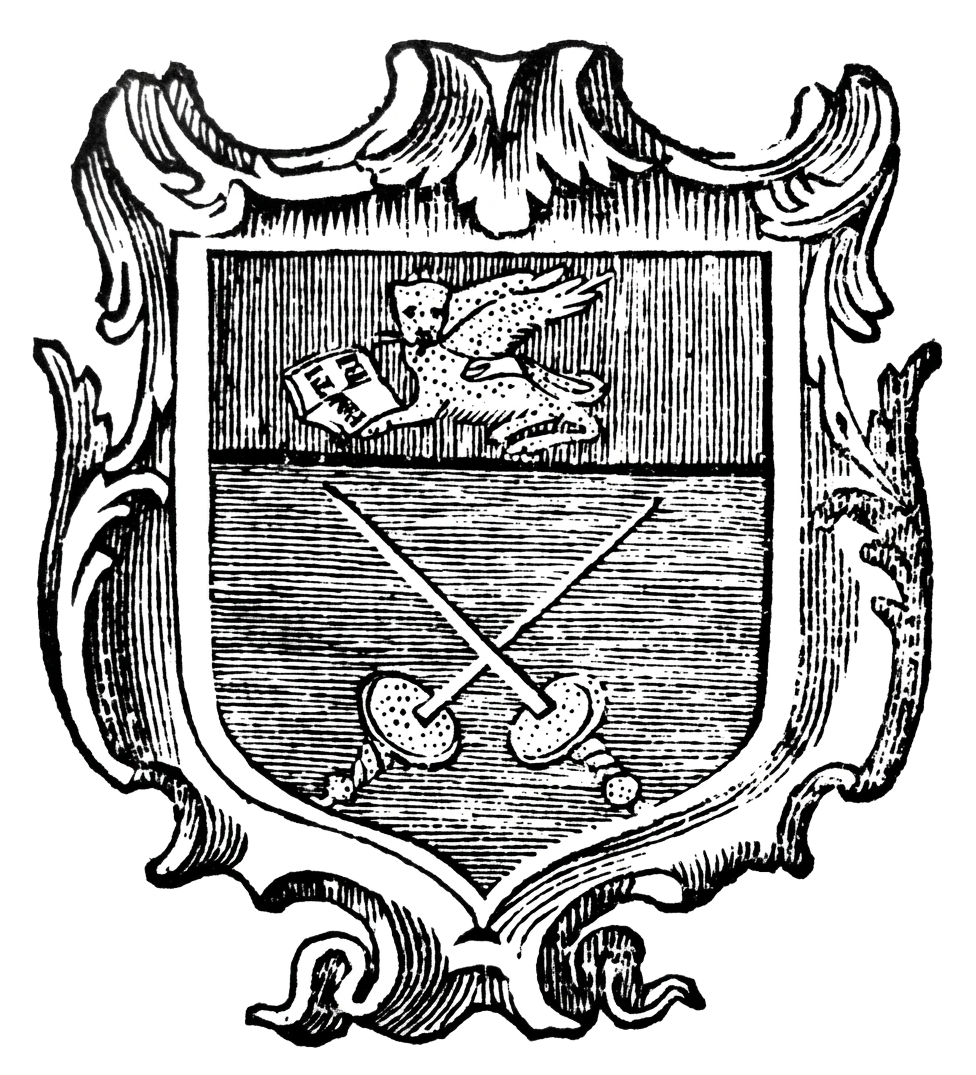
Per fess: in chief, on a field barry, a griffin segreant holding an open book; in base, two swords in saltire, points upward, pommels and hilts to base. Within an ornate Baroque cartouche.
Explore in Armorial →Born in Nancy, son of Claude II Le Clerc de Pulligny and Claudon Mengin de Pulligny. Served Charlotte Catherine de La Trémoille, Princess of Taranto and wife of Henri de Bourbon-Condé. Later a Knight of Saint Mark and, together with his brother Jean, restored to hereditary nobility on 28 May 1623. Alexandre represents the most likely continuation of the direct ancestral line following Claude II.
Alexandre Le Clerc de Pulligny was born at Nancy in 1585, son of Claude II Le Clerc de Pulligny and Claudon Mengin de Pulligny, and later resided at Érize-Saint-Dizier in Lorraine, where he is recorded as still living after 1659.
In the years following his father's disgrace during the Wars of Religion, Alexandre entered the service of Charlotte Catherine de La Trémoille, Princess of Taranto and wife of Henri de Bourbon-Condé, one of the most prominent Protestant noblewomen of the age. His position within the Bourbon-Condé household placed him at the centre of the highest princely court in France outside the royal family itself.
Like his elder brother Jean, he later entered the service of the Republic of Venice and was received into the Order of Saint Mark, a rare honour for a foreign nobleman and a mark of the trust placed in him by the Serenissima. Returning to Lorraine, he was attached to the ducal court as a musician, diplomat and valet de chambre, a position combining personal service to the sovereign with confidential business of state.
Together with his brother Jean Le Clerc, Alexandre received renewed hereditary nobility by letters patent of 28 May 1623, formally repairing the damage done to the family by their father's conversion to Protestantism and restoring the ancestral standing of the House.
Alexandre is the principal figure in the continuation of the Le Clerc de Pulligny lineage following the Wars of Religion. His descendants maintained the family's presence in Lorraine and ultimately gave rise to the later Le Clerc and Leclaire branches. Through his son Alexandre II Le Clerc (1652–1695), Minor Lord of Lorraine, the direct line passes into the eighteenth-century Leclaire family from which the modern House descends.
Biographical Record
Parents+
Son of Claude II Leclerc de Pulligny (1532–1598) and his second wife Claudon Mengin de Pulligny (1550–1626).
Children+
Father of Nicolas Le Clerc (1624–1660), through whom the direct ancestral line continues, and grandfather of Alexandre II Le Clerc, Minor Lord of Lorraine, the bridge figure between the historic Pulligny family and the later Le Claire branches.
Historical Profile+
Alexandre's career exemplifies the seventeenth-century pattern by which talented sons of noble houses combined foreign military or court service with a return to office at home. His simultaneous standing as Knight of Saint Mark and valet de chambre of the Duke of Lorraine placed him within two of the most prestigious household structures of early modern Europe.
Family Significance+
Together with Jean, Alexandre rebuilt the family's position after the confiscations suffered during the Reformation. The renewed hereditary nobility of 28 May 1623 is in significant part their work, and through Alexandre and his son Alexandre II the direct line of the House of Le Clerc de Pulligny passes intact into the second half of the seventeenth century and onward to the Leclaire branch.
Legacy+
Alexandre's name is preserved both in the records of the Venetian Order of Saint Mark and in the household books of the Dukes of Lorraine. Documentary and genealogical records show that the later Le Claire and Leclaire line of Lorraine and Alsace, from which the modern House descends, issued from his branch.
Sources & Evidence+
- Venetian state archives, Order of Saint Mark.
- Household books of the Dukes of Lorraine, valet de chambre and court musician.
- Letters patent of 28 May 1623 restoring the hereditary nobility of the House of Le Clerc de Pulligny.
Direct Line
12 generations to Brandon Noble LeClaire
Story Mode
Their chapter in the dynastyAlexandre Le Clerc de Pulligny belongs to the Wars of Religion. Born around 1585 in Nancy, Lorraine, Knight of the Order of Saint Mark (Republic of Venice). They stand at generation 7 of 19 in the documented bloodline that leads to the present House of Greenland-LeClaire.
Alexandre's career exemplifies the seventeenth-century pattern by which talented sons of noble houses combined foreign military or court service with a return to office at home. His simultaneous standing as Knight of Saint Mark and valet de chambre of the Duke of Lorraine placed him within two of the most prestigious household structures of early modern Europe.
Marriage to Madeleine Platel du Plateau bound the line to a wider noble network. Their children carried the name into the next generation.
In France, Henry III ruled. Lorraine answered to Charles III the Great. Across the wider world, french wars of religion was reshaping events.
Alexandre's name is preserved both in the records of the Venetian Order of Saint Mark and in the household books of the Dukes of Lorraine. Documentary and genealogical records show that the later Le Claire and Leclaire line of Lorraine and Alsace, from which the modern House descends, issued from his branch.
The World They Lived In
Alexandre's lifetime · 1585–1659
Who governed their world
- King of FranceHenry III
- Duke of LorraineCharles III the Great
- Holy Roman EmperorRudolf II
Contemporary figures
- William ShakespearePlaywright · 1564–1616
- Johannes KeplerAstronomer · 1571–1630
- Pierre CorneilleDramatist · 1606–1684
- Blaise PascalMathematician · 1623–1662
- Antonie van LeeuwenhoekMicroscopist · 1632–1723
Major events during their life
- French Wars of Religion1562–1598 · France
- Thirty Years' War1618–1648 · Germany
Devastates the Holy Roman Empire and Lorraine.
- Restoration of arms — Le Clerc de Pulligny1623 · Lorraine
Heraldic confirmation under Duke Henry II.
- French occupation of Lorraine begins1635 · Lorraine
- Peace of Westphalia1648 · Europe
Dynasty Explorer
See the family network
Legacy Flow
Trace what they passed on
How Did I Get Here?
Path from Alexandre to Brandon