The Master Record
History of the House of LeClaire
Being the canonical historical record of the House — its documented genealogy in the Duchy of Lorraine, its reconstructed ancestry among the ministerial nobility of the Holy Roman Empire, and its passage across the Rhine and the Channel into the modern era.
Editorial standard
Documented, Reconstructed, and In Progress
This history distinguishes rigorously between three categories of knowledge. Documented History rests on surviving contemporary charters, notarial acts, parish registers and rolls of arms, and is presented as established fact. Historical Reconstruction assembles the earlier generations of the House from onomastic, seigneurial and heraldic evidence read across published scholarship on the ministerial nobility of Lorraine; where it appears here it is identified as reconstruction, never as proof. Research in Progress marks identifications and filiations that current work is actively testing against primary sources, and which may be revised.
The documented Le Clerc line begins in the fourteenth century with Mengin Le Clerc of Lorraine. The historical horizon of the House, however, reaches back nearly a millennium. The reconstructed ancestry presently extends through the ministerial nobility of Mengen and Rollingen to Robert de Varize, active in the late eleventh and early twelfth centuries; behind him stands the wider seigneurial and ministerial nobility of the Prince-Bishopric of Metz and the Duchy of Upper Lorraine, whose rise is attested in the surviving charters of the late tenth and early eleventh centuries. That earliest horizon is treated here as historical context rather than personal filiation: no named ancestor is claimed before Robert de Varize, and the earlier generations remain the subject of continuing research. Nothing on this page is either overstated or understated on that account.
Chapter I · Introduction
A House on the Frontier
The House of LeClaire is, in the strict genealogical sense, a Lorraine family of the later Middle Ages whose documented line begins with Mengin Le Clerc, first attested in the mid-fourteenth century. In every fuller sense it is far older. Its reconstructed ancestry rises through the ministerial and seigneurial nobility of the Duchy of Lorraine, into houses whose service, castles and marriages formed the political spine of the frontier between the Kingdom of France and the Holy Roman Empire. The House thus stands on a threshold: French by later language and allegiance, German by earlier service and blood, Lorrain in every century by geography, temperament and law.
The pages that follow are not a marketing account of that heritage and not a summary. They are intended as a single, definitive historical record of the House, written in the manner of a chapter from a published family history, and organised so that every other page on this archive — each biography, each place, each heraldic entry — may draw its facts from here without contradiction. Where later research uncovers earlier documented ancestors, older charters, or additional noble alliances, this history will be extended before its dependents are updated. It is the source of truth for the House.
The narrative moves in eight broad movements. It opens with the world into which the House was born, the Duchy of Lorraine and its long life on a political frontier. It turns then to the medieval social order that made the House possible: the ministerial nobility, the rise of literate service and the meaning of the name Le Clerc itself. It reconstructs the earlier ancestry through the Houses of Varize, Rollingen and Mengen, and enters documented history with Mengin Le Clerc and the seigneurs of Pulligny. It follows the family through the confessional wars of the sixteenth century, the fiscal service of the seventeenth, the French annexation of Alsace, the crossing of the Rhine, the phonetic disguise of the name under German registrars, and finally the deliberate restoration of the LeClaire form in the modern era and its union with the English House of Greenland.
Chapter II · The Duchy of Lorraine
The Political Frontier Between France and the Empire
To understand the House of LeClaire it is necessary first to understand the country that produced it. The Duchy of Lorraine — medieval Lotharingia, the middle kingdom carved from the empire of Charlemagne’s grandsons at the Treaty of Verdun in 843 — was for a thousand years the great frontier of western Europe. It faced France on the west, the Rhineland and the Empire on the east, Burgundy on the south, and the Prince-Bishopric of Metz across its centre. Its rulers were dukes of the Empire in law and princes of Latin Christendom in fact, bound to Reims and Rome as often as to Aachen and Nuremberg.
The Duchy was not, in the modern sense, a country. It was a patchwork of duchies and counties, ecclesiastical lordships, imperial cities and free abbeys, held together by a common ducal court at Nancy, a common law of fiefs, and a common frontier culture in which French, German and Latin were all instruments of administration. The Vosges divided it, the Meuse and Moselle drew it together, and the great trade route from Champagne through Metz to the Rhine ran across it. Its towns — Nancy, Metz, Toul, Verdun, Mirecourt, Épinal, Saint-Nicolas-de-Port, and the Alsatian cities beyond — were places where notaries drew their acts in Latin, seigneurs spoke French, burghers spoke a Lorraine dialect, and the men-at-arms of the eastern fiefs answered in German.
Feudal Lorraine was built on the same layered logic as the rest of the Empire. Above stood the Duke; below him a small circle of high nobility — the counts of Vaudémont, Salm, Bar and Bitche; below them the seigneurial nobility of the country lordships; and below them, and rising steadily through the twelfth, thirteenth and fourteenth centuries, the class that concerns this history above all: the ministeriales, or ministerial nobility.
Lorraine mattered because it was where two civilisations touched. Its dukes were bilingual, its clergy tri-lingual, its charters witnessed by knights whose names were German at one court and French at another. A family that served in Lorraine could reach in two directions at once, and the House whose story is told here did precisely that.
Related reading
Chapter III · Ministerial Nobility
How Noble Service Was Made Hereditary
The ministeriales were, in origin, unfree servants of a prince or a great church, entrusted with the administration of a castle, a demesne, a mint or a chancery. In most of medieval Europe such men remained servants. In the Empire, and above all along the Rhine and in Lorraine, they became something quite different. From the eleventh century their offices tended to descend from father to son; from the twelfth century they acquired fiefs, married into the lesser knightly nobility, and were treated in charters as free men of arms; by the thirteenth they were addressed as miles or ritter, and by the fourteenth their descendants were, for every practical purpose, indistinguishable from the older feudal nobility.
This slow transformation created a distinctive Rhenish and Lorrainer nobility: literate, administrative, closely bound to bishops and abbots as well as to secular princes, and often bilingual because their service crossed linguistic frontiers. It is within this class that the earliest reconstructed ancestors of the House are to be found. They served as castellans and vögte in the fortresses of the western Empire, as receivers of episcopal rents at Metz and Toul, as jurors andéchevins in the ducal courts, and in due course as clercs and notaries whose very trade gave the family its name.
The medieval sense of clericus and its French descendant clerc was broader than the modern “clergyman”. A clericus was any man in minor orders who could read and write Latin; and by the thirteenth century a clerc, in the Lorraine sources, was a lay administrator, a scribe, a notary of the count or the bishop, a man of the pen rather than the sword. To be called li Clers in a fourteenth-century Lorraine act was to be identified by office and function. Where such a byname settled onto a lineage, it became a hereditary surname, and Moingins dis li Clers — “Mengin called the Clerk” — is exactly the kind of formulation from which the Le Clerc surname of Lorraine took its permanent form.
The evolution of hereditary surnames in Lorraine proceeded, as elsewhere in northern France and the Rhineland, unevenly through the thirteenth and fourteenth centuries. Great houses stabilised their surnames first, often from a castle or a lordship; ministerial and knightly families followed, sometimes from an ancestor’s Christian name, sometimes from an office. That the House of Le Clerc took its name from an office, at exactly the point at which such offices had become hereditary, is one of the clearest historical markers of its origin.
Related reading
Chapter IV · Research history
A Withdrawn Reconstruction: Varize, Rollingen and Mengen
Research in Progress
This chapter records a reconstruction that this archive no longer uses. It is kept so that the history of the research can be followed, and because the Varize, Rollingen and Mengen houses are genuine families of the Lorraine and Luxembourg ministerial nobility worth describing in their own right. It is not part of the canonical ancestry. The direct line above Mengin Le Clerc runs through Catherine de Gircourt and her Gircourt, Haute-Pierre, Toullon and Parroye forebears, as set out in the chapters above and on the canonical pedigree.
An earlier version of this archive joined Varize, Rollingen (French Rollange, German Rollingen) and Mengen to the documented Le Clerc line of Lorraine on the coincidence of seigneurial names, heraldic evidence and onomastic continuity. No charter was ever found naming that link, and the identification has been withdrawn.
Robert de Varize
Robert de Varize stands at the reconstructed head of the line. The lordship of Varize (modern Varize-Vaudoncourt in the Moselle) lay in the Pays messin, the country of the Prince-Bishopric of Metz. Its lords are attested from the twelfth century as vassals both of the bishop and of the counts of Bar and Salm; their arms and marriages tie them into the wider seigneurial world of northern Lorraine. It is from this house that the earliest reconstructed ancestor of the LeClaire line is taken.
The house of Rollingen
The house of Rollingen — today Reuland and Rollingen in the Grand Duchy of Luxembourg and adjacent French Lorraine — was a substantial ministerial family in the service of the counts of Luxembourg and, later, of the dukes of Lorraine and the emperors of the House of Luxembourg. Members of the wider house held the castles of Rollingen and Useldingen, served as marshals and cupbearers of the counts, and married into the houses of Reuland, Bettemburg and Roussy. The Rollingen were of exactly the type on whose steady rise from ministerial service to knightly nobility this history depends.
Johann I von Rollingen and the transition to Mengen
Johann I von Rollingen, active in the earlier fourteenth century, marks the point at which the reconstructed line begins to pass, by inheritance or by marriage, into the house of Mengen. The Mengen were a knightly family of the upper Moselle and Saargau, with holdings between the Prince-Bishopric of Metz and the Duchy of Lorraine; the surname derived from the fortified place of Mengen (Old French Moingins). It is within this house that the crucial linguistic transition of the surname is preserved in the local records.
Johann II and Johann III von Mengen
Johann II von Mengen and his son Johann III von Mengen, lord of Dalheim, carry the Mengen house into the mid-fourteenth century. Johann III married Catherine de Bauffremont by contract of 27 January 1340. They are real people with a documented record of their own, and they are not ancestors of this line: Johann III von Mengen is a different man from Mengin Le Clerc, and Catherine de Bauffremont is a different woman from Catherine de Gircourt.
An earlier version of this archive identified the Mengin called the Clerk of the 1355 Lorraine act with Johann III von Mengen, and consequently recorded his wife as Catherine de Bauffremont. That identification has been withdrawn. The canonical pedigree records Mengin Le Clerc of Deyvillers, husband of Catherine de Gircourt and father of Colin Le Clerc, at the head of the documented genealogy; the Mengen and Bauffremont material is retained only to explain the history of the research.
Related reading
Chapter V · The Documented Line
Mengin Le Clerc and the Seigneurs de Pulligny
Documented History
Mengin Le Clerc (c. 1310 – after 1355) and Catherine de Gircourt
The documented genealogy of the House begins with Mengin Le Clerc, born about 1310, active by the middle of the fourteenth century and living after 1355. He is the earliest ancestor of the line for whom contemporary Lorraine acts survive; from him every later generation of the House is descended in an unbroken sequence traceable in the ducal, seigneurial and parish records. His wife was Catherine de Gircourt, also recorded as Catherine de Girecourt, daughter of Jacques de Gircourt and Catherine de Haute-Pierre, and their son was Colin Le Clerc. Through Catherine the pedigree joins the seigneurial network of Gircourt, Haute-Pierre, Toullon and Parroye, and continues upward through Thiébaud (Liébaud) de Toullon, Marguerite de Haute-Pierre and Liébaud de Haute-Pierre, seigneur de Froville, to Simon I de Parroye and the comital house of Metz.
His life belongs to the Lorraine of Duke Jean I and Duke Charles II, a Duchy caught between the rival ambitions of France, Burgundy and the Empire, and only recently emerging from the demographic catastrophe of the Black Death. The Le Clerc of this generation were, in the surviving evidence, exactly what the reconstructed origins would predict: literate men of the ducal and episcopal administration, holding minor fiefs, marrying into local noble houses, and beginning the slow accumulation of lordships that would carry the family into the fifteenth century.
The evidence behind this generation
Level 1 — Primary record
Moingins dis li clers, also recorded as Mengin Le Clerc, of Deyvillers, appears in the Lorraine record of 1355 selling to Jean de Nomeny two inherited portions of the estate of the late Philippin de Girecourt, écuyer, at Folz beneath the castle of Faucompierre, for 26 petits florins d'or. Trésor des chartes de Lorraine, 1355, archival reference under investigation.
- Primary or contemporary record: Trésor des chartes de Lorraine, 1355, archival reference under investigation, Duchy of Lorraine, ducal archive tradition, 1355
- Older Le Clerc genealogical tradition: Guy de Rambaud, Mengin Le Clerc View source
- Older Le Clerc genealogical tradition: Guy de Rambaud, Famille Le Clerc View source
Level 2 — Canonical working pedigree
Mengin Le Clerc married Catherine de Gircourt, daughter of Jacques de Gircourt and Catherine de Haute-Pierre, and their son was Colin Le Clerc. Through Catherine the pedigree continues into the Gircourt, Haute-Pierre, Toullon and Parroye houses of Lorraine. This is the canonical direct pedigree used throughout the archive.
- Historical academic publication: Mémoires de l'Académie nationale de Metz, Éditions Le Lorrain, 1885, Volumes 63 to 64, page 122
- LeClaire family archive, internal research: LeClaire Family Historical Archive and research ledger, House of LeClaire View source
Level 3 — Withdrawn reconstruction, research history
An earlier version of this archive identified Mengin Le Clerc with Sir Johann III von Mengen, Herr zu Dalheim, and consequently recorded his wife as Catherine de Bauffremont, married by contract of 27 January 1340. That identification has been withdrawn. Johann III von Mengen and Catherine de Bauffremont are a separate couple, retained as research history only, and they are not ancestors of the House of LeClaire.
- Major published genealogical reference: Wilhelm Karl, Prinz zu Isenburg, Europäische Stammtafeln, Volume VII, Tafel 33
- Major published genealogical reference: Detlev Schwennicke, Europäische Stammtafeln, Neue Folge, Volume XXVI, Tafel 74
- Accessible derivative pedigree: Our Royal, Titled, Noble and Commoner Ancestors — Sir Johann III von Mengen and Catherine de Bauffremont View source
- Corroborating genealogical database: Stromsnes genealogical database — family record of Johann III von Mengen View source
Research history: an earlier version of this archive identified Mengin Le Clerc with Johann III von Mengen and consequently assigned Catherine de Bauffremont as his wife. The canonical pedigree records Mengin’s wife, and Colin’s mother, as Catherine de Gircourt. The Mengen and Bauffremont material is retained only to explain the history of the research.
Colin Le Clerc and Jehan Le Clerc de Pulligny
Colin Le Clerc, son of Mengin, carried the line into the earlier fifteenth century. His son Jehan Le Clerc, active c. 1410 and again in the documentary record c. 1465, took the seigneurial style de Pulligny from the lordship in the Vosges foothills that would remain the family’s principal territorial designation for two centuries. The seigneurie of Pulligny, held of the Duke of Lorraine, was the seat from which the senior line would style itself; from Jehan onwards the family is properly named Le Clerc de Pulligny. His noble status was formalised by letters patent of 3 January 1464, the first documented ennoblement of the House and the fifteenth-century charter to which the two later grants — the re-grant of arms to Claude and Thierry in 1512 and the hereditary ennoblement of Alexandre in 1623 — look back as their point of origin.
Mengin II Le Clerc (fl. c. 1498)
Mengin II Le Clerc, flourishing at the end of the fifteenth century, consolidated the family’s standing in Nancy and its lordships in the Xaintois. He is recorded in the burgher rolls of the ducal capital and in the acts of the seigneurial jurisdictions of Pulligny and Mirecourt. His generation is the pivot between the late medieval and early modern history of the House.
Claude Le Clerc de Pulligny (1485–1562)
Claude Le Clerc de Pulligny, Sieur de Pulligny, husband of Catherine de Trèves de Xirocourt, is the first fully documented seigneurial head of the House in the modern sense. His marriage to a daughter of the de Trèves de Xirocourt allied the Le Clerc to the petite noblesse of the Xaintois and to the wider network of noble houses centred on Mirecourt. His life spanned the reigns of Duke René II, Duke Antoine and Duke Charles III, and the whole first act of the Reformation in Lorraine.
Claude II Le Clerc de Pulligny (1532–1598)
Claude II Le Clerc de Pulligny, Treasurer of the Company of the Count of Vaudémont, carried the family into ducal military and financial service in the second half of the sixteenth century. The Vaudémont were the junior branch of the House of Lorraine and, from the reign of Duke Charles III, its principal military instrument. To hold the treasury of a Vaudémont company was to sit at the meeting-point of court finance and provincial war; it is in his generation that the family enters the fiscal and military nobility of the Duchy in earnest.
Alexandre Le Clerc de Pulligny (1585–after 1659)
Alexandre Le Clerc de Pulligny, secretary to Charlotte Catherine de La Trémoille, Princess of Taranto, Knight of Saint Mark, and recipient of hereditary nobility in 1623, is the pivotal figure of the seventeenth-century House. His court service to a princess of the House of La Trémoille brought the family into the highest French princely circle of the age; the grant of hereditary nobility in 1623 formalised a status that his ancestors had, in every practical sense, held for two centuries. His life carried the House through the calamities of the Thirty Years’ War and the French occupation of Lorraine.
Nicolas Le Clerc (1624–1660) and Alexandre II Le Clerc (1652–1695)
Nicolas Le Clerc, son of Alexandre, and his son Alexandre II Le Clerc continued the family through the mid- and later seventeenth century. Their lives coincide with the ruin of the Duchy in the wars of Louis XIII and Louis XIV, the French annexation of the great cities, and the beginning of the slow reorganisation of the Lorraine nobility under a French administrative order. The senior line was diminished, but not extinguished, by the wars; the branches that would carry the House into the eighteenth century were already in place.
Pierre Leclerc du Vivier and Chrestienne Le Clerc du Vivier
Pierre Leclerc du Vivier, Treasurer General of Lorraine and financial administrator to major princely households, stands with his kinswoman Chrestienne Le Clerc du Vivier at the head of the collateral du Vivier branch of the House. Chrestienne’s funerary monument is preserved within the Louvre Museum, and stands as one of the most tangible surviving witnesses of the family’s standing in the fiscal nobility of early modern France.
Blessed Alix Le Clerc (1576–1622)
Among the collateral kin of the House stands Blessed Alix Le Clerc, founder of the Congregation of Notre Dame and one of the most influential educational reformers of her era. Born in Remiremont in 1576 and dying in Nancy in 1622, she is the subject of an extensive hagiographical and historical literature; her canonical beatification in 1947 gave the wider Le Clerc kin of Lorraine a recognised place in the religious history of the Duchy.
Nicolas II Le Clerc (1705–1769)
Nicolas II Le Clerc, gentleman of the Duchess of Lorraine, wealthy merchant, estate administrator and tax farmer, carried the House through the last generation of independent Lorraine. His life ended six years after the Duchy’s incorporation into the Kingdom of France on the death of the ex-King Stanislas in 1766; he is the last figure of the House to have lived under a Duke of Lorraine as sovereign prince.
Related reading
Chapter VI · Allied Noble Houses
Marriages, Castles and Political Networks
A noble house is not only a line of descent; it is a network of marriages. The Le Clerc de Pulligny were bound, across four centuries, to a series of houses whose lands, offices and arms shaped their political horizon. Each of these alliances is documented in the seigneurial and parish records; each meant more than a marriage. In an age when a noble marriage settled a dowry, opened a court, secured a garrison, and often decided a confessional allegiance, the alliances of the House deserve to be read as political history.
Trèves de Xirocourt
The marriage of Claude Le Clerc de Pulligny to Catherine de Trèves de Xirocourt tied the House into a family of the Xaintois with lands at Xirocourt and estates along the upper Moselle. The Trèves were of long-standing knightly nobility, with a documented presence in the Duchy from the thirteenth century; their arms and their alliances placed the Le Clerc within the seigneurial society of the ducal south.
Gircourt, Parroye, Haute-Pierre, Toullon
The wider circle of houses joined to the Le Clerc by the Gircourt marriage included the Gircourt (or Girecourt), a knightly family of the Vosges holding a lordship near Épinal; the Parroye, seigneurs of the country around Lunéville; the Haute-Pierre, their cadet branch of the northern Vosges, seigneurs de Froville; and the Toullon of Lorraine. To marry among these houses was to enter the political administration of the Duchy at its most enduring level.
Raville, Warsberg and the German Lorraine
Along the German frontier of the Duchy stood the houses of Raville and Warsberg, whose castles guarded the passes between the Saar and the Nied and whose service to the emperor and the Duke alike made them exemplary of the bilingual ministerial nobility from which the reconstructed ancestry of the House also emerges. Their alliances with the Rollingen and the Mengen in earlier generations, and with the Le Clerc du Vivier and their kin in later ones, form part of the wider evidentiary picture on which the reconstruction of the origins rests.
The Gircourt marriage, and the Bauffremont of the research history
The marriage of Mengin Le Clerc to Catherine de Gircourt is the earliest recorded alliance of the House and the point at which the pedigree joins the seigneurial genealogy of the Vosges: the Gircourt, a knightly family holding a lordship near Épinal, whose estates appear in Mengin’s 1355 act concerning inherited portions of the estate of the late Philippin de Girecourt. An earlier version of this archive identified Mengin with Johann III von Mengen and so recorded his wife as Catherine de Bauffremont; that reconstruction has been withdrawn and the Bauffremont are retained here only as research history.
Related reading
Chapter VII · Heraldry
The Arms of the House and Their Evolution
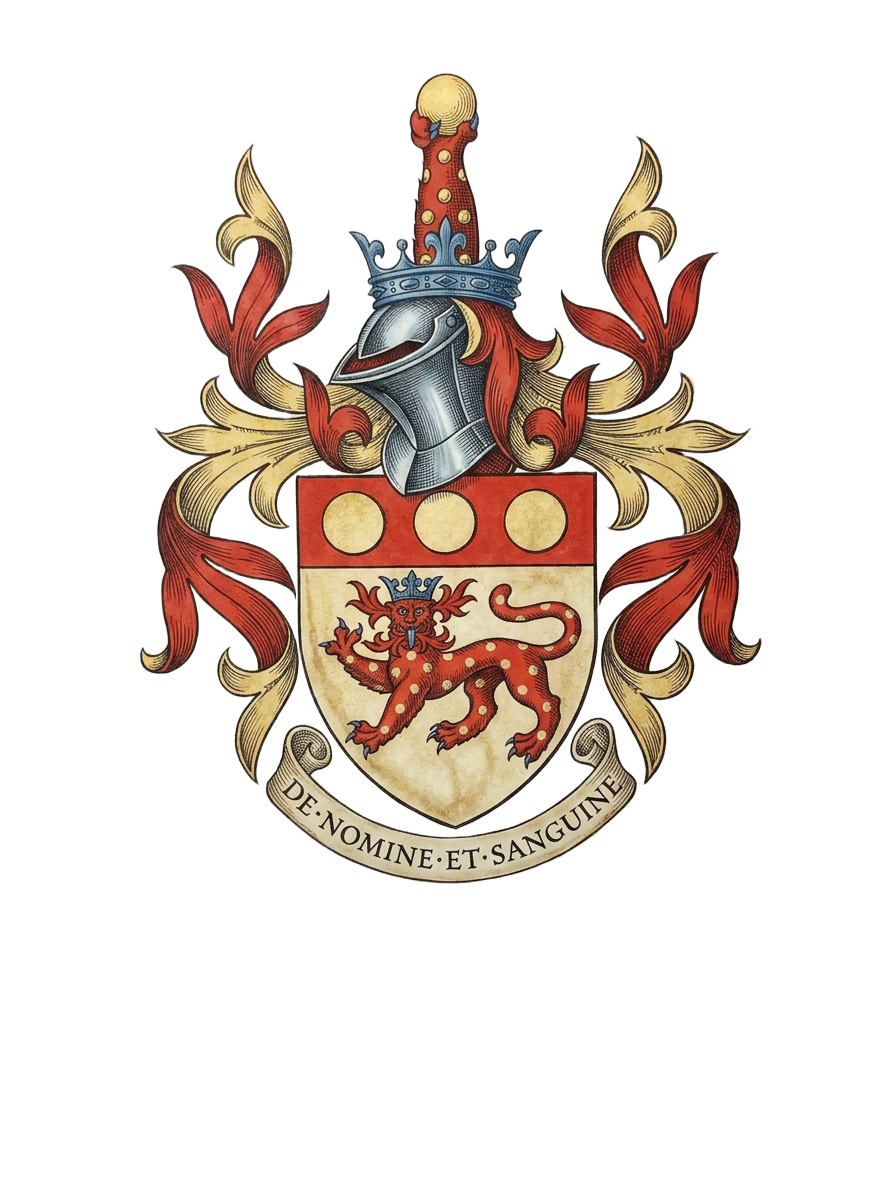
The heraldic history of the House is written across a series of rolls of arms, seals and armorials from the fifteenth to the eighteenth century. The senior line of Le Clerc de Pulligny bore arms consistent across these witnesses, and in the seventeenth century their heraldic identity was formally restored in the act of ennoblement of 1623. The cadet branches — du Vivier and the later Alsatian and Rhenish branches — carried differenced versions of the same arms into their own service.
The arms of the allied houses — Trèves de Xirocourt, Gircourt, Pulligny, and, in later generations, Vandevyvere and Greenland — are preserved in the archive of this site alongside those of the House itself. Blazons are recorded here in strict heraldic terms and never invested with invented symbolic meaning; the meaning of a coat of arms lies, for the House, in the documented act of its grant and the offices and lands of the family that bore it, not in modern allegorical readings.
A cadet branch does not bear the same arms as the senior line; it bears them differenced. The seventeenth-century restoration of the Le Clerc de Pulligny arms after the grant of nobility of 1623 preserved this distinction between the senior line and the various collateral branches, and it is that distinction which allows the modern reconstruction of the heraldic history of the House to be undertaken with confidence.
Related reading
Chapter VIII · Reformation and Religion
Lorraine, Trent and the Wars of the Faith
The Reformation reached Lorraine in the 1520s and became a political question in the 1550s. The dukes of Lorraine remained Catholic and firm; the frontier with the Rhineland and the Empire brought the family into daily contact with Protestant Alsace and Protestant Palatinate; the presence of a strong Jesuit and reforming Catholic revival in Nancy after the Council of Trent shaped the ecclesiastical culture within which the House lived.
The Le Clerc remained Catholic. Their alliances with the Vaudémont, the La Trémoille and later the Jesuit foundations of Nancy tied them firmly to the Counter-Reformation. The presence of Blessed Alix Le Clerc among the collateral kin of the House exemplifies this: the Congregation of Notre Dame, which she founded, became one of the great educational instruments of Catholic reform in the Duchy.
The Wars of Religion did not spare Lorraine, but they touched it less catastrophically than they touched France. The greater calamity of the age was still to come: the Thirty Years’ War, which entered the Duchy in the 1630s, halved its population, and drove Duke Charles IV into exile.
Related reading
Chapter IX · Across the Rhine
The Germanisation of the House
After the French annexation of Alsace in 1681, a mercantile and military branch of the House established itself in Strasbourg. From there, through the eighteenth and nineteenth centuries, successive generations passed by trade, military service and marriage across the Rhine into the German Southwest and the Rhineland. The passage was not sudden and it was not a rupture; it was a slow bilingual transition of a kind familiar to Alsatian families of the period.
The evolution of the surname across those two centuries reflects that passage. It moves through the successive forms:
- Le Clerc — the settled Lorraine form of the documented senior line.
- Leclerc — the compressed spelling adopted in French administrative usage from the sixteenth century onwards.
- Le Claire and Leclaire — forms taken by the Strasbourg and Rhenish branches from the late seventeenth century onwards, preserved in the Revolutionary and Napoleonic civil registers.
- Le Clair and Leclair — adopted in the Rhineland as Lower Rhine clerks dropped the silent final e.
- Licklär — the phonetic transcription settled on by German registrars in the late nineteenth and early twentieth centuries, under which the family’s French origin was almost wholly obscured.
- LeClaire — the deliberate modern restoration of the French form, a rediscovery of the family’s documented origins in Lorraine and of the historic House of Le Clerc.
The changes are not corruptions. They are the ordinary linguistic adaptation of a bilingual frontier family through French, German and Latin administration across three centuries. The Lorraine dialect of the earlier generations, the standard French of the Revolutionary state, the German of the Prussian registrar and the restored French of the modern archive are all part of the same continuous history of the name.
Related reading
Chapter X · Places of the House
Nancy, Pulligny, Mirecourt, Strasbourg, Dalheim and Beyond
The geography of the House is inseparable from its history. Its principal places, each of which appears repeatedly in the documented record, may be read as a map of its life.
Nancy
Capital of the Duchy of Lorraine. Ducal court, chancery, treasury and university. Successive generations of the Le Clerc held bourgeois offices at Nancy and appear in the burgher rolls of the city; Alexandre Le Clerc de Pulligny served here at the courts of the Vaudémont and the La Trémoille.
Pulligny
Seat of the seigneurie from which the senior line took its style. A lordship of the Vosges foothills, held of the Duke of Lorraine, and the territorial designation borne by the head of the House from the fifteenth century onwards.
Mirecourt
Market town of the Xaintois. Meeting-point of the alliance with the Trèves de Xirocourt, and the seat of the jurisdictional business of the Le Clerc lands in the southern Duchy.
Strasbourg
Alsatian capital and, after 1681, a French royal city. The point of departure of the mercantile and military branch of the House and the pivot on which its passage into the Rhineland turned.
Dalheim
A place on the German Lorraine frontier associated with the wider network of ministerial and knightly houses within which the reconstructed origins of the House are found.
Faucompierre
A minor lordship of the Vosges holdings of the Le Clerc, held by cadet lines through the sixteenth and seventeenth centuries.
Related reading
Chapter XI · Britain
The Passage into England and the Modern House
Through the nineteenth and twentieth centuries, branches of the House descended from the Alsatian and Rhenish lines passed progressively into Britain. The modern English House of Greenland-LeClaire emerges from this passage: the allied English families of Greenland and Pigott, and the LeClaire descent restored to its Lorraine form, converge in the modern generation.
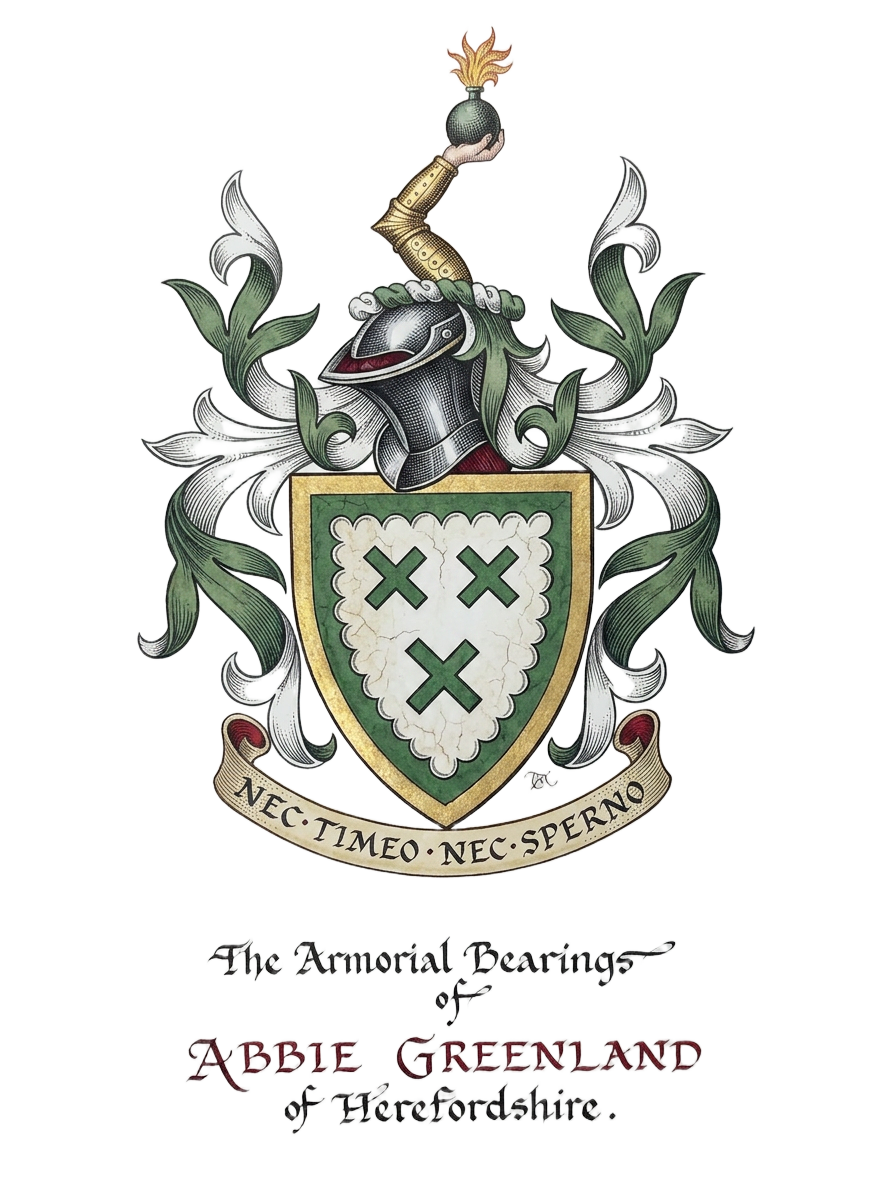
The union of Brandon Noble LeClaire and Abigail Jane Greenland-Pigott on 22 May 2027 formalises the emerging identity of the modern House. It is an identity of two continents of ancestry: on the LeClaire side, the documented and reconstructed Lorraine line described above; on the Greenland-Pigott side, an English descent whose paternal line runs through the Pigott of Richard Pigott, and whose maternal line runs through the Greenland of Debbie and Colin Greenland, bearing the historic Greenland arms of Argent, three saltires Vert within a bordure engrailed party Or and Vert, with a crest of a dexter arm armoured embowed Or sustaining a grenade fired Proper.
The Greenland-LeClaire identity is emerging, not historic; it is the modern chapter of a much older story. Its place in this record is precisely that: the newest chapter of the History of the House of LeClaire.
Chapter XII · Chronology
The Documented Timeline of the House
The following chronology gives, in strict order, the documented generations of the House from Mengin Le Clerc onwards, together with the immediate reconstructed generations above him. Each entry is marked with the evidentiary category that governs it.
late 10th c.
Rise of the ministerial nobility of the Prince-Bishopric of Metz and the Duchy of Upper Lorraine — the historical milieu from which the reconstructed line emerges. No named ancestor is claimed for this horizon.[1]
Research in Progressearly–mid 11th c.
Earliest attested seigneurial families of Varize, Rollingen and Mengen in the Pays messin and Luxembourg marches, from which the reconstructed filiation of the House is drawn.[2]
Research in Progresslate 11th – early 12th c.
Robert de Varize — earliest identifiable ancestor of the reconstructed line[2]
Historical Reconstructionc. 1410, c. 1465
Colin Le Clerc; Jehan Le Clerc de Pulligny (ennobled by letters patent, 3 January 1464)[4]
Documented History19th–21st c.
Direct LeClaire descendants and the modern restoration of the surname[5]
Documented History
Citations & sources for the chronology
Every entry above carries a numbered reference to the record or study that attests it. Footnote markers in the chronology link directly to the reference below.
Université de Nancy II · 1982
Published Scholarly ResearchFull reference: Michel Parisse, Noblesse et chevalerie en Lorraine médiévale, Université de Nancy II, 1982- 2.Jean Schoos, studies on the seigneurial families of the Luxembourg marches (Rollingen, Mengen, Dalheim)↩
Publications de la Section historique de l'Institut G.-D. de Luxembourg
Published Scholarly ResearchFull reference: Jean Schoos, studies on the seigneurial families of the Luxembourg marches (Rollingen, Mengen, Dalheim), Publications de la Section historique de l'Institut G.-D. de Luxembourg - 3.Charter recording the sale of inherited portions at Folz beneath the castle of Faucompierre by Moingins dis li clers↩
Duchy of Lorraine, seigneurial act · 1355
Earliest surviving act naming the ancestor of the House.
Primary SourceFull reference: Charter recording the sale of inherited portions at Folz beneath the castle of Faucompierre by Moingins dis li clers, Duchy of Lorraine, seigneurial act, 1355 Chancery of the Duchy of Lorraine · 3 January 1464
Primary SourceFull reference: Letters patent of ennoblement granted to Jehan Le Clerc de Pulligny, Chancery of the Duchy of Lorraine, 3 January 1464Archives départementales de Meurthe-et-Moselle, de la Moselle, du Bas-Rhin; Landesarchiv
Contemporary RecordFull reference: Parish, notarial and seigneurial registers of Lorraine, Alsace and the Rhineland, Archives départementales de Meurthe-et-Moselle, de la Moselle, du Bas-Rhin; LandesarchivChancery of the Duchy of Lorraine · 1623
Primary SourceFull reference: Letters of confirmation and restoration of nobility to Alexandre Le Clerc de Pulligny, Chancery of the Duchy of Lorraine, 1623
Sources for the earliest horizon (late 10th – 12th c.)
The late tenth- and early eleventh-century entries do not name individual ancestors. They frame the historical milieu — the ministerial and seigneurial nobility of the Prince-Bishopric of Metz, the Duchy of Upper Lorraine and the county of Luxembourg — from which the reconstructed Varize–Rollingen–Mengen line is drawn. The framing rests on the standard modern scholarship on that nobility: Michel Parisse, Noblesse et chevalerie en Lorraine médiévale (Nancy, 1982) and La Lorraine monastique au Moyen Âge; Jean Schoos, Der Machtkampf zwischen Burgund und Orleans and his studies on the Rollingen (Rollange) and the ministeriales of Luxembourg; and the printed cartularies of the Bishopric of Metz (ed. Wolfram, Pertz) and of the abbeys of Gorze, Saint-Arnoul and Saint-Vincent de Metz. Named filiations begin only with Robert de Varize in the late eleventh / early twelfth century, and remain reconstructed until the documented sequence opens with Mengin Le Clerc in the surviving Lorraine act of 1355.
Chapter XIII · Standards of Evidence
How This History Handles Uncertainty
Where the earliest documented ancestor is Mengin Le Clerc, this history says so. The ascent above him runs through his wife, Catherine de Gircourt, into the Gircourt, Haute-Pierre, Toullon and Parroye houses, and is labelled generation by generation according to the strength of the evidence behind it. An earlier reconstruction of this archive identified Mengin with Johann III von Mengen and is retained only as research history. The distinction between documented genealogy, historical reconstruction and research history is preserved throughout.
Nothing on this page is presented as certain that is not certain, and nothing is understated that the evidence supports. The objective, held across every generation, is academic integrity: to make the House of LeClaire visible in the historical record on precisely the terms the evidence allows.
This history is not static. If future research uncovers earlier documented generations — a charter naming Mengin Le Clerc as the son of a named father, an act tying the Mengen and Rollingen lines to a Lorraine ancestor of the fourteenth century, a heraldic confirmation of the reconstructed arms — the narrative will be extended before Robert de Varize, and the distinction between documented evidence and reconstruction will be maintained throughout. Every dependent page — biography, timeline, pedigree, place and heraldic entry — is expected to draw its facts from this record and to be updated after it, never before.
A Rediscovery
“The modern restoration of the LeClaire name is a rediscovery of the family’s documented origins in Lorraine, and of the historic House of Le Clerc from which it descends.”